
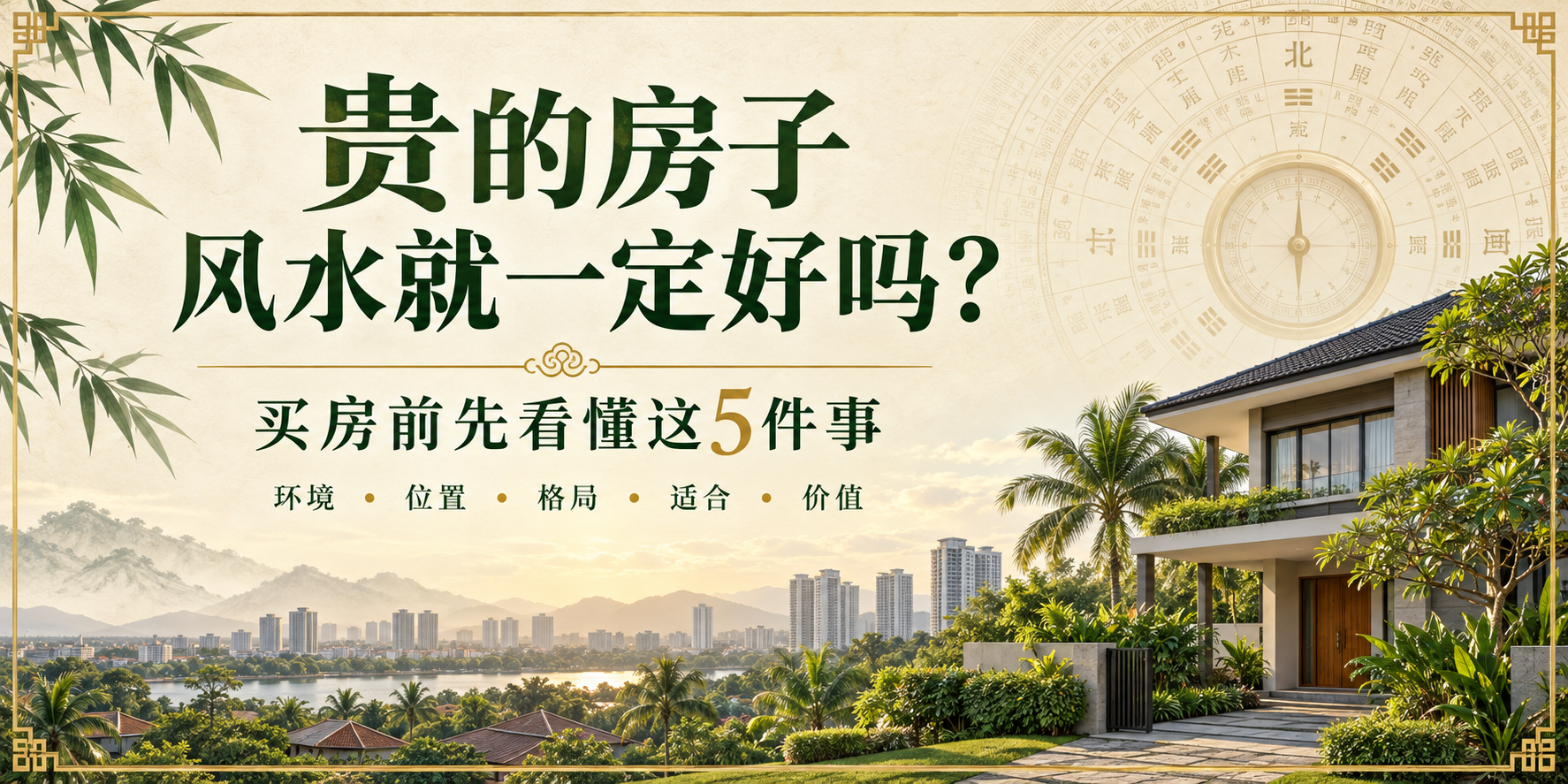
By 2026, the cost of buying a house has become increasingly higher.
According to the latest real estate data for the first quarter of 2026 released by the National Real Estate Information Centre (NAPIC) under the Valuation and Property Services Department (JPPH) of the Ministry of Finance of Malaysia,
The Malaysian government continuously monitors national residential property prices, transaction volumes, and real estate transactions in various states and territories.
Johor also has its own separate real estate transaction data for the first quarter of 2026.
For those planning to buy a house in Johor Bahru, Iskandar Puteri, or Kulai, the price of a house is certainly a very real issue.
RM500,000, RM800,000, RM1 million, or even higher, are no longer unfamiliar figures today.
Therefore, when we are preparing to spend such a large sum of money to buy a house, it is natural to have a certain feeling:
"This house is so expensive, its feng shui must be pretty good, right?"
That's not necessarily true.
High housing prices and good feng shui are not necessarily directly equivalent.
Why does a house sell for RM1 million?
Possible reasons include: location, land value, developer brand, transportation, commercial facilities, school district, market demand, and even future development potential.
These conditions determine its market value.
Traditional Feng Shui, however, observes something else entirely:
- What is the terrain and environment of the entire area like?
- How does the road lead to the region?
- Is there an open space in front of the house?
- Are the surrounding buildings oppressive to the house?
- Are the lighting, ventilation, and air intake conditions suitable?
- Is the interior layout suitable for long-term living?
- etc.
Therefore, even in the same upscale residential area, with the same price exceeding RM1 million, two houses just a few streets apart may have completely different environments and layouts.
House prices reflect how the market values a house;
Feng shui focuses on whether the environment and layout are suitable for people to live in for a long time.
Therefore, when buying a house, instead of just asking, "Is this house expensive?"
Perhaps we should ask another question: "Is this house really suitable for us to live in?"
Many people have a very natural thought when looking at houses:
The more expensive the house, the better the location, and the better the feng shui should be, right?
Especially for high-end residences, luxury homes, freehold projects, or houses located in the city center, prestigious school districts, or established communities, the prices may be much higher than those in the vicinity.
Some apartments are even more expensive than landed apartments.
However, from a feng shui perspective, high housing prices do not necessarily mean good feng shui.
Because housing prices and feng shui are actually two different things.
Housing prices are typically influenced by factors such as location, land price, developer, building quality, transportation, commercial facilities, school district, and market supply and demand.
Feng shui, on the other hand, considers:
- Is the environment in this area stable?
- Is the layout of the house reasonable?
- Can air get in?
- After moving in, is one's living situation comfortable and stable?
- etc.
Therefore, even a house worth millions can have feng shui problems.
1. A good location doesn't necessarily mean the house itself is in a good spot.
Within the same residential area, some units may face a park, some a main road, some are close to a T-junction, and some are next to high-voltage power towers, slopes, ditches, or large buildings.
Although the addresses are the same and the house prices may be similar, the environment faced by each house is actually completely different.
Feng shui is not just about "which district you live in", but rather: the specific location of your house.
Sometimes, even in a very expensive residential area, the following may occur:
- The main gate faces the road directly.
- The house is located on the outside of a sharp bend.
- The oppressive building in front
- The Mingtang is too narrow
- Imbalance between left and right environments
- The area behind was empty and unsupported.
- Long-term exposure to large construction sites
These problems won't disappear automatically just because housing prices are high.
It is also important to note that these conditions cannot be considered alone to make a judgment that "the feng shui is bad." In reality, it is still necessary to combine distance, direction, proportion, and the overall environment for judgment.
2. Are high-rise buildings with permanent landscape features necessarily good feng shui?
Many high-rise apartment buildings emphasize:
- Unbeatable sea view
- "Urban Landscape"
- "Unobstructed views from high-rise buildings"
- "Permanent landscape"
From the perspective of living experience, the view is certainly very important.
However, from a feng shui perspective, we need to examine this further:
How did this scene enter the house?
For example, some units may have a very open view, but the wind is too strong, the sunlight is too intense, or the entire balcony is constantly exposed to strong winds.
Some units, despite being very tall, are located close to another building.
Therefore, feng shui is not simply about judging whether "seeing mountains is good or seeing water is good".
The key is to see if the overall environment is pleasant and stable, and whether the house can truly bring in good environmental conditions.
3. A large size in a luxury home does not necessarily mean a good layout.
A large mansion does not necessarily mean a good layout.
Some houses, even those that are five or six thousand square feet, may have the following problems inside:
- The back door is directly visible as soon as the main door opens.
- The staircase faces the main entrance.
- The toilet is located in the center of the house.
- Irregular room shape
- Difficult to place at the head of the bed
- The location of the kitchen stove is affected by the beam.
- The living room is large, but there are very few spaces where energy can truly gather.
A large area simply means a lot of space.
Having more space doesn't necessarily mean that the space will be used well.
Feng shui truly focuses on how a space allows people to live, rest, move around, and gather.
4. Even with an expensive house, it's important to consider whether it's suitable for the people living there.
The same house can have different experiences for different people.
Some people value career development, some hope for family stability, some are preparing for retirement, some families have young children, and some family members work from home for extended periods.
Therefore, when choosing a house, in addition to looking at the external environment and house layout, you can also take into account the birth charts of family members as a reference for directions, room arrangements, bed positions, etc.
When actually viewing a property, I usually suggest looking at the environment and layout first, and then further considering the individual's birth chart.
First look at the overall environment, then look at the house; avoid obvious problems first, then consider how to be traditionally associated with good fortune.
If a house already has obvious problems in its external environment, it should not ignore other more important factors just because "the direction suits my birth chart".
Feng shui is not just about finding a so-called "auspicious direction".
Instead, they first avoid obvious environmental and layout issues, and then choose a unit that is more suitable for themselves and their families from among the better-quality houses.
5. A truly worthwhile house to buy is one that is "expensive for a reason."
So, does that mean we shouldn't buy expensive houses?
Of course not.
Many high-priced residences do indeed have better environments, planning, green spaces, road conditions, landscapes, and living quality.
But the problem is:
We need to know why we are paying this price.
If the price is mainly due to the brand, decoration, marketing packaging, or market popularity, and the actual environment and layout of the house do not have corresponding advantages, then it is worthwhile to take a closer look before buying the house.
Buying a house and considering feng shui isn't about finding the "perfect house."
In reality, very few houses can be rated 100 points.
What you really need to do when buying a house is to know:
- What questions are acceptable?
- Which issues can be adjusted later?
- Which problems are best avoided from the beginning?
For example, some interior layout issues can often be adjusted during the renovation process.
However, external conditions such as roads, buildings, terrain, and surrounding environment are usually difficult to change after purchase.
Therefore, when viewing a house, I usually first look at the overall environment, then the specific location of the house, and finally go inside to see the layout.
An expensive house doesn't necessarily have good feng shui.
A relatively inexpensive house does not necessarily mean that its feng shui is bad.
House prices reflect how the market values a house;
Feng shui focuses on whether the environment and layout are suitable for people to live in for a long time.
If you are preparing to buy a house in Johor Bahru, Iskandar Puteri, Kulai, Kuala Lumpur, or Singapore, and have already narrowed down several residential, condo, or landed properties but are unsure how to choose, you can make a comprehensive comparison based on the external environment, location, layout, orientation, and the actual needs of your family members before making a final decision.
Often, what we really need to find isn't the most expensive one.
Instead:
The one that's more suitable for you and your family to live in long-term.
FAQ | Common Questions about Feng Shui When Buying a House
1. Does an expensive house necessarily have good feng shui?
uncertain.
Housing prices are mainly affected by factors such as location, land value, transportation, developer brand, building quality, surrounding amenities, and market supply and demand.
Feng shui, on the other hand, observes the external environment of a house, its terrain, roads, surrounding buildings, the flow of qi (energy), and its interior layout.
Therefore, a house worth RM1 million does not necessarily mean that its feng shui is better than that of a house worth RM500,000.
Housing prices reflect market value, while feng shui observes whether the environment and layout are suitable for long-term living.
2. When buying a house, what is the most important thing to look at first in terms of feng shui?
It is generally recommended to look at the overall environment first, and then look at the house itself.
This includes the overall terrain of the area, the direction of roads, surrounding buildings, whether the area in front of the houses is open, and whether there are any factors nearby that significantly affect the living environment.
After confirming the overall environment, then further examine the house's orientation, air intake, lighting, ventilation, and internal layout.
Because the interior layout can be adjusted later, but roads, terrain and surrounding buildings are usually difficult to change after buying a house.
3. Why do the feng shui of each house in the same residential area differ?
Even within the same residential area, each house may face different environments.
For example, some houses have open spaces in front, while others face main roads; some are located at road bends, while others are close to large buildings, slopes, or other environmental conditions.
Therefore, one cannot conclude that the feng shui of every house in a residential area is the same simply because the price of the house is high and the location is good.
Ultimately, feng shui should be judged based on the specific house and its location.
4. Do different blocks, stacks, and floors in a condo have different feng shui?
meeting.
Even within the same condo project, different blocks, stacks, floors, and orientations may result in different roads, buildings, views, sunlight, and wind conditions.
For example, in the same project, one stack may have a more open view in front, while another stack faces neighboring buildings for a long time; the external environment that high-rise and low-rise floors are exposed to is not exactly the same.
Therefore, when choosing a condo, in addition to looking at the project itself, you should also look at the specific block, stack, floor and unit environment.
5. Are high-rise condos with permanent views necessarily better in terms of feng shui?
uncertain.
High floors and open views usually offer better views, but feng shui is not simply about judging by "the higher the better" or "being able to see mountains and water is good".
If the unit is located in a location with strong winds or severe sun exposure for a long time, or if it is on a high floor but is oppressed by neighboring buildings, it is necessary to make a judgment based on the actual situation.
The view is one factor, but it is not the only criterion for judging the feng shui of a residence.
6. Which has better feng shui: a landed property or a condo?
There is no absolute better or worse option.
Landed properties typically require more consideration of the land, roads, terrain, house shape, surrounding environment, and surrounding buildings.
In addition to the overall project environment, it is also necessary to further determine the relationship between blocks, stacks, floors, orientation, and neighboring buildings in a condo.
Therefore, instead of asking "Is a landed or condo better in terms of feng shui?", a more practical question should be:
What is the environment and layout of the house you are planning to buy?
7. When buying a house, is it necessary to consider the homeowner's birth chart (Ba Zi) when choosing a feng shui partner?
It's possible to coordinate, but it's generally recommended to first look at the basic environment and layout of the house, and then further refer to the birth charts of family members.
If a house already has obvious problems with its external environment or layout, it is not advisable to ignore the house's own conditions simply because a certain direction "matches the Eight Characters" (a Chinese astrological concept).
The Eight Characters (Ba Zi) can be further used as a reference for directions, room arrangement, bed and space usage.
It would be more reasonable to first choose a house with a good environment and layout, and then select a unit that is more suitable for yourself and your family from among them.
8. If a husband and wife have different birth charts, whose chart should be prioritized when buying a house?
It is not advisable to decide the entire house based solely on one person's birth chart.
In actual assessment, it is also necessary to consider both spouses, the primary occupants, children, and other long-term family members, while also taking into account the environment, layout, and purpose of different spaces in the house.
A family home is ultimately a space where multiple people live together, so it needs to be considered holistically, rather than just looking for one person's "auspicious direction".
9. Is it necessary to check the feng shui before buying a house in Johor Bahru?
Whether or not one needs to consult feng shui depends on how much importance one places on their living environment.
If you are planning to buy a home in areas such as Johor Bahru, Iskandar Puteri, or Kulai, especially if you have already shortlisted a few landed properties or condo units, you can further compare their external environment, roads, location, orientation, and internal layout before making a final decision.
Even within the same residential area, the actual environment can vary depending on the street, the location of the row houses, or even just a few houses apart.
10. What should I pay attention to when looking at the feng shui of a condo in Singapore?
In addition to the location of the entire condo project, you can also observe the surrounding roads, adjacent buildings, block location, stack, floor, orientation, openness in front, lighting, wind conditions, and the internal layout of the unit.
In particular, Singapore has a high density of residential buildings, and the architectural relationships between different blocks and stacks may vary significantly.
Therefore, it is not advisable to judge the feng shui of a unit simply because the project is expensive, has a good location, or is on a high floor.
11. When is it most suitable to consult a Feng Shui master about a property? Before or after purchasing?
If you want to use feng shui as one of the factors to consider when choosing a house, the ideal time is after you have narrowed down a few units, but before you make a final decision.
This stage allows for comparison of the external environment, location, and layout of different houses.
Because interior issues may be renovated and adjusted later, but once a house is purchased, the external roads, terrain, buildings, and neighboring structures are usually unchangeable.
Even if you've already bought a house, you can still analyze and arrange the layout based on the existing conditions. This doesn't mean you don't need to consider feng shui after buying a house.
12. I have already selected 2-3 houses. Can I ask a feng shui master to help me compare them?
Can.
If you have already narrowed down 2-3 houses to your liking, you can further compare them in terms of the overall environment, specific location, roads, orientation, surrounding buildings, air intake, and interior layout.
If needed, the birth dates and times of family members can also be used as a further reference for the arrangement of rooms, directions, and spaces.
Buying a house and checking its feng shui isn't about finding a "perfect, flawless" house, but rather about helping yourself understand:
Which one has fewer problems?
Which issues can be adjusted?
What problems are best avoided before buying?
Ultimately, by comprehensively considering various factors such as actual budget, living needs, real estate conditions, and living environment, one can choose a house that is more suitable for oneself and one's family to live in long-term.
