
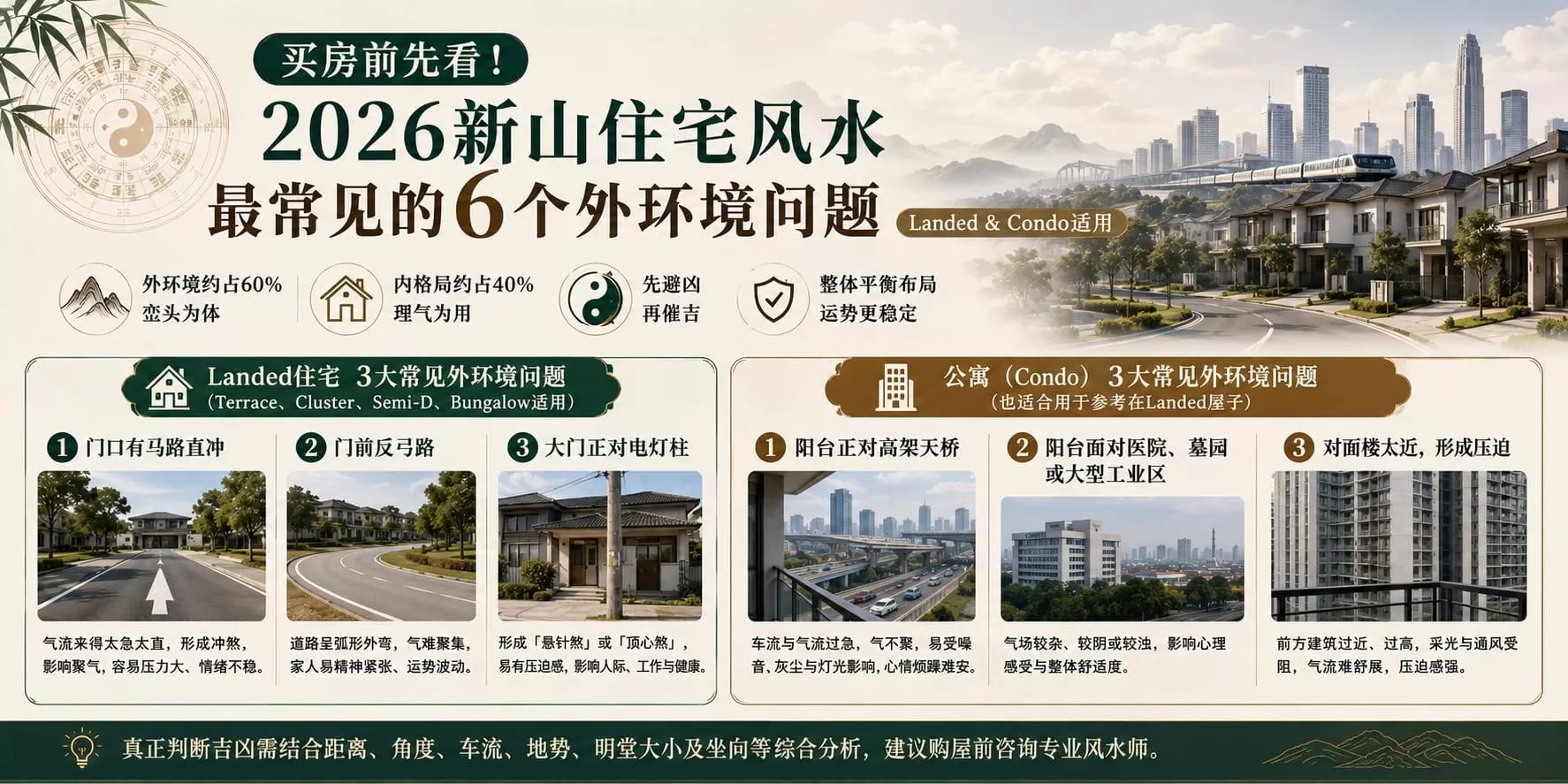
How important is the feng shui of the external environment of a home?
There is an ancient saying in Feng Shui: "The physical landscape is the foundation, while the principles of Qi (energy) are the application."
Simply put, Luan Tou refers to the external environment surrounding a house; Li Qi refers to the layout and arrangement of the house.
In terms of importance, Feng Shui practitioners generally believe that the external environment accounts for about 60% of the total area, while the interior layout accounts for about 40% of the total area.
Humans live in a large environment, and the quality of that environment naturally affects our quality of life.
A good external environment makes people feel more comfortable and at ease; an undesirable external environment may bring noise, a sense of oppression, or make the flow of movement in and out inconvenient.
Therefore, when conducting a feng shui survey, in addition to observing the layout of the house, it is also necessary to understand the overall environment surrounding the residence.
In recent years, Johor Bahru's real estate market has once again attracted attention. This is due to the following developments:
-
Johor-Singapore Special Economic Zone (JS-SEZ)
The cross-border economic development plan jointly promoted by Malaysia and Singapore aims to attract more businesses, talent and investment to Johor, thereby driving regional economic growth. -
RTS Johor Bahru-Singapore Rapid Transit System
It is expected to be operational by the end of 2026, with the entire journey taking only a few minutes, which will greatly improve the convenience of commuting between Singapore and Malaysia. -
Data Center Development
Johor has become a key hub for data centers in Southeast Asia. By the end of 2025, Johor has approved more than 50 data center projects with a total investment exceeding RM180 billion, attracting the attention of many international technology companies.
(Excerpt from:)investjohor.gov.my) -
Forest City and Financial District Planning
Forest City has been included as one of the key development areas in the Johor Bahru-Singapore Special Economic Zone and has received financial and commercial policy support, further increasing market demand and attention for real estate.
With the signing and completion of various large-scale infrastructure projects, the market is generally optimistic about Johor's development prospects.
This has attracted many investors and owner-occupiers to start paying attention to the real estate market in the Johor Bahru area.
However, whether for investment or personal use, when buying a house, one should not only consider location, price, and development potential; the external environment of the residence itself is also an important factor.
In the Johor-Singapore area, especially Johor Bahru, the most common house types are: terrace houses, semi-detached houses, bungalows, and condominiums.
These house types all have some common external environmental issues that deserve attention.
The following is a summary of the most common feng shui issues related to the external environment of residences in 2026:
The most common external environmental issues for landed residences (suitable for Terrace, Cluster, Semi-D, Bungalow)
1. There is a road directly facing the front of the house.
The courtyard of the house is called the Bright Hall. The Bright Hall is characterized by its spaciousness, breadth, and brightness. A spacious and open Bright Hall makes it easier for energy to gather, and it also symbolizes more room for development and opportunities.
If there is a road directly in front of the house, the airflow is too fast and too straight, which can easily create a negative energy flow and affect the original energy-gathering effect of the Mingtang (bright hall).
Long-term residence can easily lead to stress and emotional instability, and residents are more likely to experience repeated fluctuations or sudden situations in their lives.
Self-check:
Stand at the gate and look out to see if there are any roads, driveways, or alleys that lead directly to the gate.
If the traffic is fast, the road is straight, and the distance is short, special attention is usually required, and further judgment is recommended.
2. Road curving away from the entrance
A reverse bow road refers to a road or river outside a house that curves outward in an arc, with the house located on the outer side of the arc, as if it were being cut off by the back of the bow.
In such environments, there is often a lot of instability, making it difficult for energy to accumulate, and family members are more likely to experience mental stress.
However, the auspicious or inauspicious influence of a reverse-bow road cannot be generalized. It is also necessary to determine the size of the curve, the distance, the speed of traffic flow, and whether it is directly opposite the main gate.
The closer the distance and the faster the traffic flow, the more obvious the impact.
Self-check:
Stand at the gate and look out to observe whether the traffic flows close to the house.
If you feel that the road has "cut" or rammed into you, you need to pay more attention.
3. The main gate faces a lamppost.
The main entrance is the intake point for Qi (energy). If there are lampposts, utility poles, or large trees blocking the way in front of the main entrance, it may form a "hanging needle" or "top heart" configuration in Feng Shui.
Because airflow and views are obstructed, it can easily create a feeling of oppression. In Feng Shui, such an environment is more likely to cause interpersonal problems, increased work obstacles, and minor health issues or accidental injuries.
Self-check:
Standing at the main entrance and looking out, observe whether lampposts, utility poles, or large trees are directly aligned with the center line of the entrance. If they are very close, tall and prominent, or create a sense of visual oppression as soon as you open the door, you need to pay special attention and it is recommended to further assess whether adjustments or solutions are needed.
The most common external environmental problems in condos (also applicable to landed houses)
1. The balcony faces the elevated pedestrian bridge.
The balcony is the main location in an apartment for receiving air and natural light.
If a balcony faces an elevated overpass, highway, or main road where traffic flow and air currents are rapid, it can easily create an environment where energy cannot accumulate. In addition, family members may feel irritable and restless, and be affected by noise, dust, and light.
Self-check:
Stand on the balcony and look out to observe whether there is traffic rushing directly towards your workplace, or whether the overpass is close to the balcony. The closer the distance and the faster the traffic, the more obvious the impact.
2. Balcony facing a hospital, cemetery, or large industrial area.
High-rise apartments offer a wide view, but if the balcony faces a hospital, cemetery, large industrial area, or abandoned building for a long time, it can easily create a mixed, yin, or turbid external environment in terms of feng shui.
Although it may not pose an immediate problem, it can affect the residents' psychological feelings and overall comfort.
Generally speaking, the lower the floor, the closer the distance, and the more direct the line of sight, the more obvious the impact.
Self-check:
Stand on your balcony and look out to see if you can see these places visually. If they are far away and the line of sight is not direct, the impact is less; if they are close and directly in front of you, further assessment is needed.
3. The building opposite is too close, creating a sense of oppression.
Apartments are most vulnerable when buildings are too close, too tall, or too dense in front of them. If the balcony or window faces the wall of another building when opened, it can create a feeling of oppression and also affect lighting, ventilation, and the openness of the space in front of the apartment.
Feng shui emphasizes that "the open space in front of the house should be spacious." If the space in front is too close, too high, or too oppressive, it will not only make people feel uncomfortable visually, but it will also make it difficult for airflow to spread, affecting the gathering of energy and the visual comfort of the residents.
The closer the distance and the taller the building, the more oppressive the feeling.
Self-check:
If you stand on the balcony and your view is completely blocked by the building opposite, or if you feel that the space is too cramped, then you need to be careful.
Conclusion: Before buying a house, first consider the external environment.
The above checks are only suitable for preliminary observation. To truly determine the auspiciousness or inauspiciousness of the external environment, it is necessary to combine factors such as distance, angle, traffic flow, terrain, size of the open space in front of the house, as well as the orientation and layout of the house itself, and make a conclusion based on a single phenomenon.
Whether it's a terrace house, semi-detached house, bungalow, or condominium, the feng shui of a residence should not only focus on the interior layout, but also on the surrounding external environment. Problems such as road intersections, roads curving away from the property, high-voltage power towers, sharp angles pointing towards the property, and obstructed views in front of the house do not necessarily indicate a bad residence, but they are all worth noting and evaluating before purchasing.
Driven by the Johor Bahru-Singapore Special Economic Zone (JS-SEZ), the RTS MRT system, and various large-scale infrastructure projects, more and more people are paying attention to the Johor Bahru real estate market. In addition to location, price, and development potential, the surrounding environment of a residence also affects the comfort of living and the overall feng shui.
Buying a house is a long-term plan, and the focus of residential feng shui is not just on judging good or bad fortune, but also on choosing a space that is more suitable for yourself and your family to live in after understanding the environment and layout.
Hopefully, this article will help you pay more attention to the overall environment of the surrounding area when viewing or buying a house, in addition to focusing on price and location.

 English
  Chinese