The elephant was once one of the totems of Emperor Shun's clan. Later, the descendants of Emperor Shun developed into the Shang people, so the Shang people also inherited their ancestors' totem tradition related to elephants.
Therefore, we can often see elephant patterns and shapes on bronzes, sculptures and other cultural relics left from the Shang Dynasty.
This also reflects that elephants were not just ordinary animals in the Shang Dynasty, but may have had important totemic and sacred symbolic significance.
Legend has it that when King Zhou of Shang began using ivory chopsticks, his uncle Ji Zi was very worried.
Ji Zi was not just worried about a pair of chopsticks, but that if a person starts to pursue luxury and enjoyment, his desires may grow bigger and bigger, and he may eventually lose the reverence and restraint he should have.
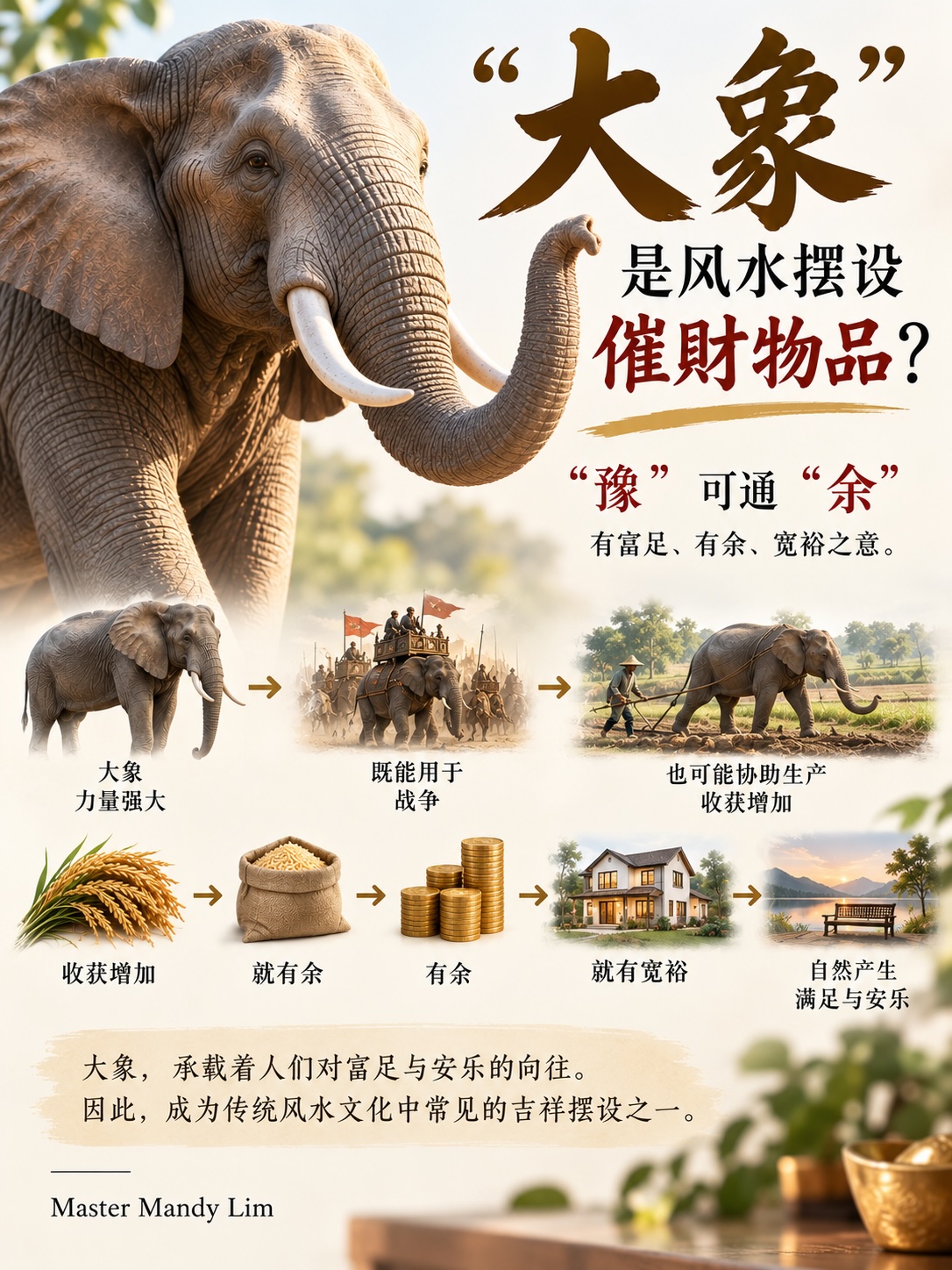
The "Ancient Music" chapter of the Lüshi Chunqiu also records that the Shang people once tamed elephants and used them in warfare. In addition, elephants were also used to help with production.
Whether in war or production, elephants can be helpful to humans, expanding their power and leading to greater gains.
When the harvest increases and material resources become more abundant, people naturally feel more satisfied. Later, the character "豫" gradually came to mean harmony and happiness.
"豫" can also be used interchangeably with "余".
The silk manuscript of “余” can help us understand “豫” from another perspective: having surplus or abundance, which is a state of wealth and abundance.
therefore:
Elephant → By leveraging the strength of elephants → Increased harvest → Abundance and sufficiency → Satisfaction and contentment → Hesitation.
However, the Yu hexagram does not stop at "happiness" and "peace and happiness".
Although "豫" means joy and happiness, it does not mean that people should only seek pleasure, but rather that they should know how to act in accordance with the times.
The core principle is: "Move in accordance with the natural order."
Don't rush into action when things aren't going well or the situation isn't ripe.
Even when conditions are ripe and the situation is favorable, don't miss the opportunity or delay taking action.
Act when it's time to act, and stop when it's time to stop, following the natural course of events.
However, once people enter a period of good fortune, when life is stable and they are content, it is easy for them to increasingly enjoy the happiness in front of them.
When happiness reaches its peak, it can turn into unrestrained enjoyment, attachment to the experience, and even lingering without wanting to leave.
This is human nature, and it's also what the Yu hexagram specifically reminds us of.
Therefore, the six lines of the Yu hexagram actually represent different states of a person in the state of "Yu":
The sixth day of the month, "Ming Yu": Before truly entering the state of Yu, one has already shown great pride, joy, and even ostentation.
The sixth line, "between the stone": When one is in a time when one can be happy and enjoy oneself, one can still remain clear-headed and firm, and not be easily led astray by happiness.
The sixth line, "Hesitation": It means merely looking up and observing others, hesitating and waiting, unable to grasp one's own actions in a timely manner.
The fourth hexagram, "Yu" (豫), signifies that when the time for "Yu" (豫) has truly arrived, one can act in accordance with the circumstances, thereby bringing joy to all.
The sixth line, "Zhen Ji": The person in Yuzhong has already encountered problems, like having an illness, but is still able to maintain it, so "he will not die".
The sixth line, “Ming Yu”, means that one has reached the extreme of pleasure and is so engrossed in it that one lingers in a daze, reluctant to leave.
Therefore, the six lines of divination present a complete process of change:
Prepare yourself before the time comes → Prepare yourself and you can maintain your composure → Observe and hesitate → Act in accordance with the trend → There is danger in preparation → Excessive preparation leads to addiction.
Therefore, the Yu hexagram emphasizes acting in accordance with the times, while also reminding us that joy should not be excessive.
Only by acting in accordance with the times and remaining clear-headed amidst comfort can one avoid going from "contentment" to "delusion."
Since "豫" can be used interchangeably with "余", meaning abundant, plentiful, and well-off,
It's not hard to understand why elephants later became one of the common auspicious decorations in traditional Feng Shui, symbolizing abundance, good fortune, and wealth.
From "象" to "豫", and from "豫" to "余", even a single character from the ancients contains a layer of wisdom about life.
