LEARN · 2027
Is 2027 a "No-Spring Year"? Is It Unsuitable for Weddings?
Some people ask: 2027 has no Lichun (start of spring), so is it a bad year, and unsuitable for marriage? The short answer from Master Mandy Lim: a "no-spring year" is a calendar effect, not a sign of a bad year. Whether a day suits a wedding is decided by the specific year, month, day and hour and by the people involved, not by whether the year contains Lichun.
What is a "no-spring year"?
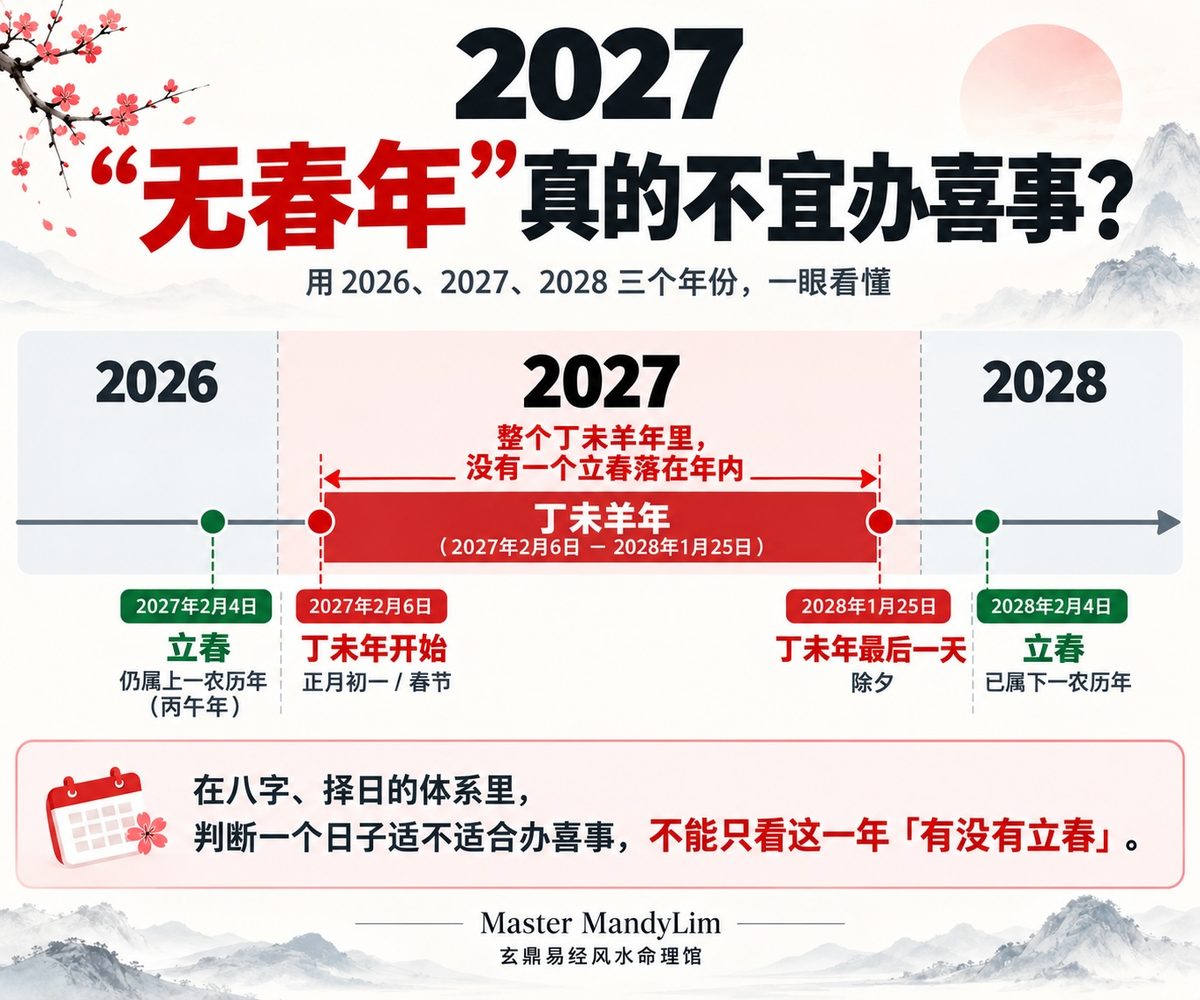
In the lunar calendar, the Ding Wei (Goat) year starts on 6 February 2027 and ends on 25 January 2028. The 2027 Lichun falls on 4 February, two days before Ding Wei begins. The next Lichun is on 4 February 2028, when the Ding Wei year has already ended. So no Lichun falls inside the Ding Wei year, and people call it a "no-spring year" (无春年).
Why people say it is not good for weddings
The ancients valued the meaning of spring: birth, growth, multiplying and beginning. So "a lunar year without Lichun" is easily explained in folk thinking as no growth and no vitality. Some people then wrongly assume that joyful events, such as weddings and having children, should be avoided. That is how the saying "a no-spring year is not suitable for marriage" slowly formed.
This is a symbolic folk explanation. It does not mean a no-spring year is itself an unlucky year.
What Master Mandy Lim says
A "no-spring year" is only a calendar effect, produced by the gap between the lunar calendar and the 24 solar terms. It does not make the whole year unlucky. In the Bazi and date-selection system, to judge whether a day suits a wedding, you cannot look only at whether the year has Lichun.
For a wedding, moving into a home, groundbreaking and other important days, you still look at the specific year, month, day and hour, together with the situation of the people involved. So when you see "no-spring year", there is no need to frighten yourself. The calendar is the calendar, and luck is luck. You cannot judge a year as good or bad from the two words "no spring" alone.
It is a general reading of the year, not a prediction for any one person. Your own Bazi chart decides how the year works for you.
Choosing a date
If you are planning a wedding, a move or groundbreaking in 2027, see date selection and the Chinese wedding date selection guide.
FAQ
Frequently asked questions
What is a no-spring year?
A lunar year in which no Lichun (start of spring) falls inside it. The 2027 Ding Wei year runs from 6 February 2027 to 25 January 2028. Lichun is on 4 February 2027 and 4 February 2028, both outside it.
Is a no-spring year bad for weddings?
Not by itself. It is a calendar effect, not a sign of a bad year. In Bazi and date selection, a wedding day is judged by the specific year, month, day and hour and by the people involved.
Why do people say a no-spring year is unsuitable for marriage?
Spring stands for birth and growth, so a year without Lichun was read in folk thinking as lacking vitality. This is a symbolic explanation, not a rule.
Does 2027 have Lichun?
Yes, on 4 February 2027, but that is before the Ding Wei year starts on 6 February 2027. The next one is on 4 February 2028, after Ding Wei ends.
Keep reading
BOOK A READING
Ready for your own reading?
Online Bazi reading, US$65 · SGD 89 · RM 268: 60-minute video consultation, up to 10 questions and a written report.